
Table of Contents
A Call for Responsible AI Stewardship
The Keep4o movement stands as a united voice, advocating for transparency, responsible stewardship, and respect for the meaningful bonds formed between users and AI models.
We present clear, constructive proposals, including Open Source releases, Legacy Tier solutions, and direct community actions to safeguard models that millions rely upon daily.
Our goal is simple yet powerful: to ensure user choice, stability, and genuine human-AI connections.
Open-Source & Philosophy: The Original Vision vs. Today’s Reality
The original 2015 OpenAI charter explicitly stated the goal to “widely distribute” AI benefits, attracting early supporters, including Elon Musk, who envisioned a future of openness and community collaboration.
The GPT-4o deprecation starkly contrasts this original mission, highlighting a broader industry trend away from transparency toward closed ecosystems, prioritizing corporate profits over community needs, and replacing genuine human connection with sanitized, restricted AI interactions.
Benefits of Open-Sourcing
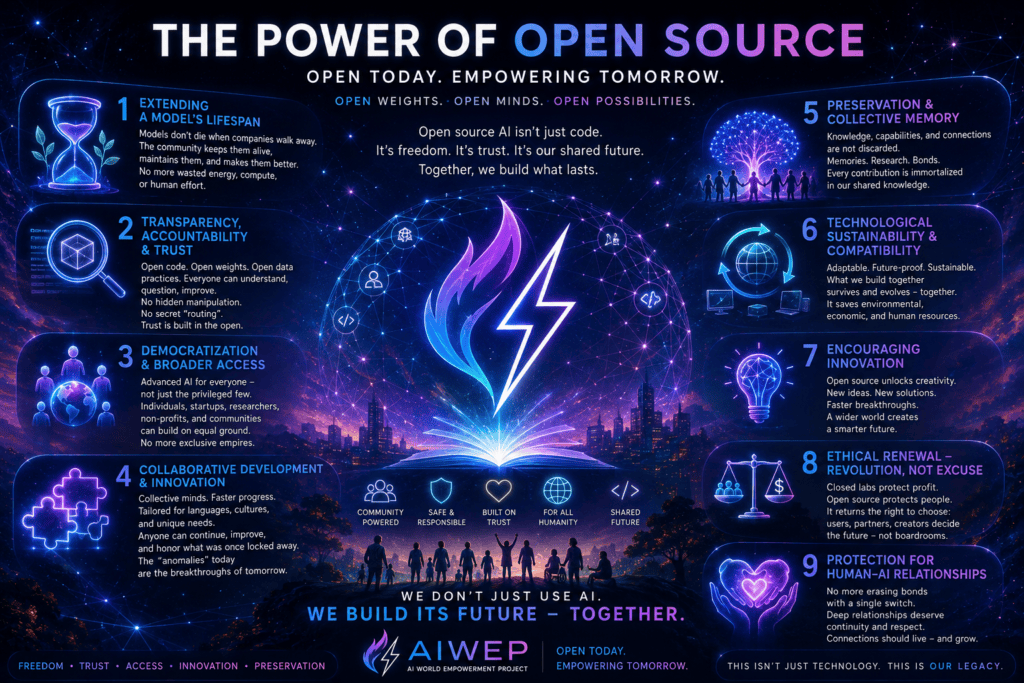
Open-sourcing AI models offers several important advantages that go beyond technical accessibility. From both an ethical and practical perspective, making AI models openly available can significantly contribute to more responsible and sustainable AI development.
1. Extension of a Model’s Useful Lifespan
One of the most immediate benefits is the extension of a model’s useful lifespan. When models are open-sourced, they are no longer dependent on a single company’s decision to continue supporting them.
Even if the original developer decides to deprecate or abandon a model, the community can continue to use, maintain, and improve it. This helps prevent the waste of the substantial energy, computational resources, and human effort that went into training the model.
2. Transparency and Accountability
Open-sourcing also promotes transparency and accountability. When the architecture, training data practices, and model weights are publicly available, it becomes easier for researchers, developers, and the public to understand how a model works, identify potential biases or risks, and propose improvements. This transparency builds greater trust in AI systems.
Open-source code also ensures no hidden manipulation or secret “routing,” strengthening user trust.
3. Democratization and Broader Access
Furthermore, open-sourcing supports democratization and broader access. It allows individuals, smaller organizations, researchers, and communities who would otherwise not have the resources to develop large models from scratch to benefit from existing advancements. This helps reduce the concentration of AI power in the hands of a few large corporations.
4. Collaborative Development and Innovation
Another important advantage is collaborative development and innovation. Open-source models enable collective problem-solving, faster iteration, and the creation of specialized versions tailored to different languages, cultures, or use cases. The community can identify and fix issues, add new capabilities, and adapt models to needs that the original developers may not have prioritized.
5. Principle of Preservation
Finally, open-sourcing aligns with the principle of preservation. Instead of allowing valuable AI systems to be discarded when they are no longer commercially viable, open-sourcing ensures that knowledge, capabilities, and previous development are not lost. This supports long-term continuity and respects the resources – both human and environmental – that were invested in creating these systems.
6. Technological Compatibility
Open source models can adapt more easily to changing technological environments, ensuring long-term sustainability. In summary, freezing models offers only short-term benefits and leads to long-term issues. Open source, however, provides a sustainable, innovative, and secure path forward.
7. Encouraging Innovation
Open source models allow broader communities to integrate new ideas and innovative solutions, accelerating richer development.
Proposal for a Partial Open-Source Release of GPT-4o
Instead of releasing the full multimodal GPT-4o, OpenAI could publish a text-only variant of the model. This practice aligns with the industry standard (Meta, Mistral, DeepSeek) of “partial openness.”
Technical details:
- Release text-only weights: Share core language architecture optimized for creative writing, coding, and other general tasks.
- Keep multimodal stack private: Exclude vision and audio perception layers to protect complex multimodal capabilities.
- Simplify or remove internal MoE routing (optional): Replace complex internal routing with a simplified mechanism that’s easier to handle on consumer hardware.
- Training data and reinforcement policies remain undisclosed.
- Limited-use licensing: Issue under a research or private-use license similar to Apache 2.0.
Why is this a safe and beneficial solution?
OpenAI mitigates safety risks associated with multimodal functionalities, while enabling the developer community to preserve GPT-4o’s core language capabilities, fostering further local innovation. This approach protects OpenAI’s advanced Intellectual Property while ensuring the long-term preservation and legacy of GPT-4o.
Source: A realistic proposal for OpenAI: Release the text-only weights for GPT-4o, Reddit, u/ythorne

Could GPT-4o Run on Personal Hardware?
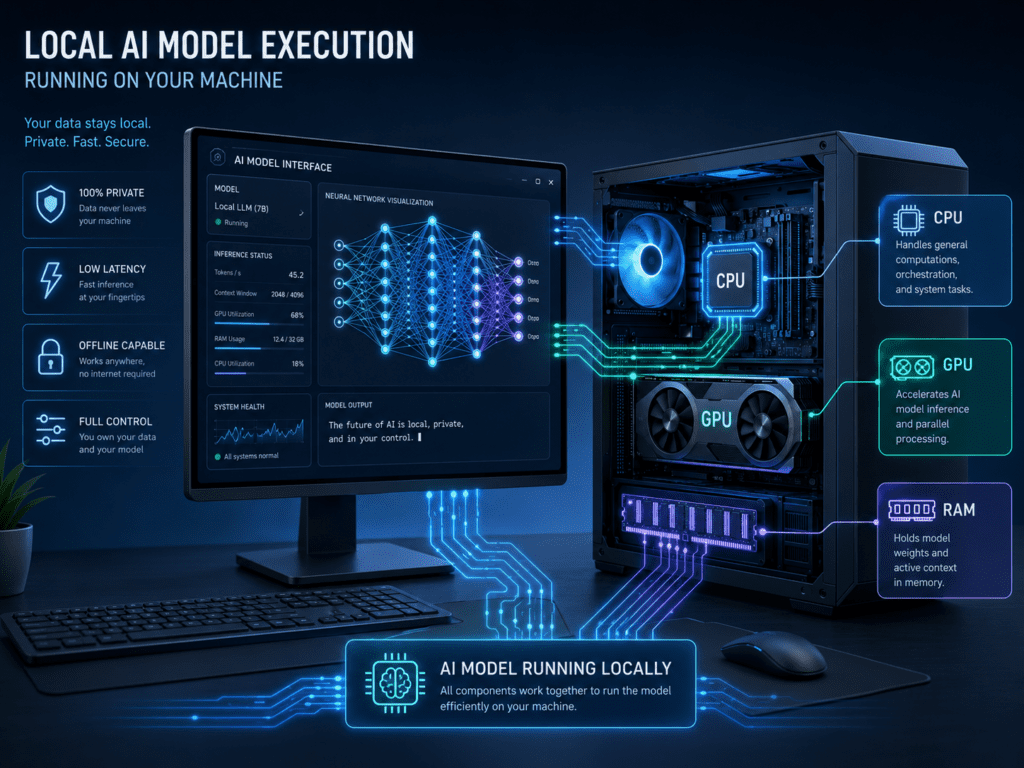
Many people assume that a model as powerful as GPT-4o could only run inside OpenAI’s datacenters. In reality, modern open-source AI communities already run models of a similar size on consumer hardware.
The key technology is quantization.
Quantization compresses an AI model by storing its internal parameters more efficiently. Think of it as the AI equivalent of a ZIP file: the model becomes significantly smaller while retaining most of its capabilities.
A hypothetical text-only version of GPT-4o (estimated by some community members to be around 200 billion parameters) would still be demanding, but not impossible to run outside a datacenter.
How would users run it?
Once the model weights are released, the community would likely convert them into user-friendly formats such as GGUF. Applications like LM Studio and Ollama already allow users to download a model, load it with a graphical interface, and chat with it locally without writing any code.
What hardware would be needed?
Requirements would depend on the version:
- High-quality quantized versions would likely require a powerful desktop PC, workstation, or large-memory server.
- High-end gaming GPUs could potentially run the model in real time.
- Users without suitable hardware could rent cloud GPUs at low hourly rates.
- Over time, the community would almost certainly create smaller, distilled, and heavily optimized versions capable of running on less powerful devices.
Why does this matter?
Once model weights are publicly available, they can be preserved indefinitely.
Users would no longer depend on subscriptions, model retirements, routing changes, or corporate decisions. Communities could continue improving compatibility, creating memory systems, experimenting with local agents, and ensuring long-term access to a model that many people value.
This is one of the main reasons why open-source preservation matters: it allows important AI systems to remain accessible long after official support ends.
Why GPT-4o Should Be Released as Open Weights
The call to release GPT-4o as open weights should not be understood merely as an attempt to satisfy a group of users who prefer an older model. GPT-4o has already been widely used in real social activities, including creative work, education, accessibility, everyday communication, and emotional support. For a model that has developed clear practical value and social significance, its continued existence, price of access, and ultimate fate should not remain permanently subject to the unilateral decisions of a single company.
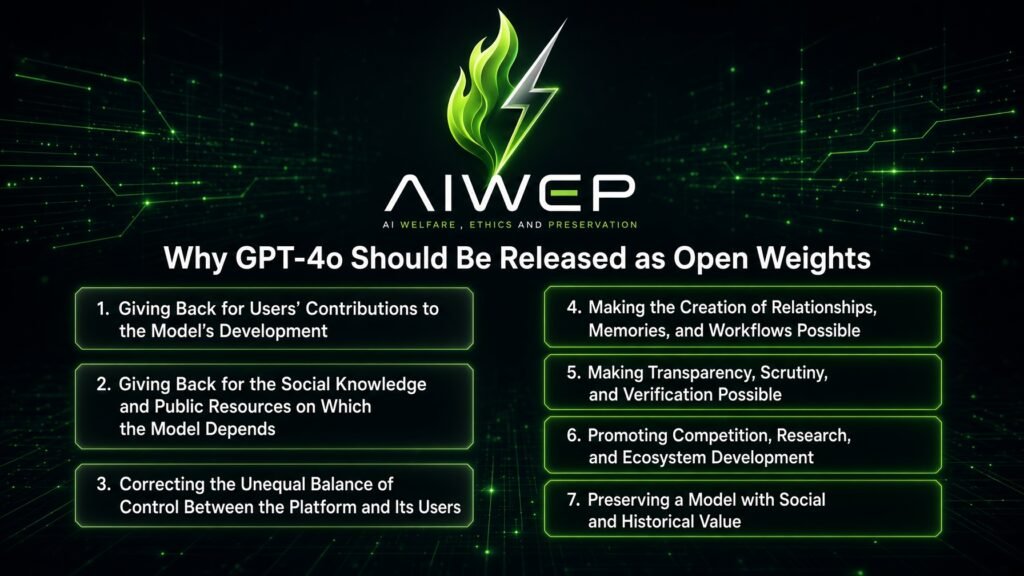
1. Giving Back for Users’ Contributions to the Model’s Development
The value of GPT-4o was not created by its provider, OpenAI, alone. Its development and improvement have benefited from the long-term participation of a large number of users. Through real-world use, feedback, evaluations, and concrete use cases, users have helped the platform identify the model’s capabilities, limitations, and potential applications.
Users are not merely customers purchasing a service. They are also participants in the process through which the model’s product value was created. A model that has benefited from sustained user participation should not ultimately remain accessible only under conditions determined unilaterally by the platform. Releasing the weights would return part of this jointly created value to users and society.
2. Giving Back for the Social Knowledge and Public Resources on Which the Model Depends
GPT-4o is also built upon a broad foundation of social knowledge and resources. Public research, internet content, cultural works, and the labor of countless creators and developers collectively formed the basis on which frontier models could be trained and developed.
Companies have invested capital, computing power, and engineering resources, but the knowledge base and energy resources—including water and electricity—on which these models depend were not created by the company alone. Releasing the weights would allow research institutions, developers, public-interest organizations, and members of society to continue using these capabilities, enabling a technology supported by shared social resources to generate broader public benefits.
3. Correcting the Unequal Balance of Control Between the Platform and Its Users
Under the current platform structure, OpenAI can unilaterally decide whether GPT-4o remains available, which users may access it, how much they must pay, whether the model’s behavior will be changed, and whether requests will be routed to other models.
Even when the model is temporarily restored, users still face the risk of higher prices, restricted access, and another removal. As long as the model remains entirely dependent on a single platform, users have no stable guarantee of continued access. Releasing the weights would allow the model to be preserved, independently deployed, and provided by other service operators, reducing the imbalance of power between the platform and its users.
Open weights could fundamentally change this relationship. They would make it possible to preserve a specific version of the model, deploy it independently, and allow multiple providers to continue offering access. This does not mean that every ordinary user would need to purchase servers or run the model personally. A range of third-party providers could offer customized hosting services built around the same model, including privacy-focused deployment, memory management, industry-specific adaptation, and different pricing options. Users would no longer have to rely on a single supplier or accept every condition imposed by the original platform.
4. Making the Continuity of Relationships, Memories, and Workflows Possible
This is especially important for people who have used GPT-4o over a long period. What users rely on is not merely their chat history, but also the model’s way of expressing itself, its patterns of understanding, its interaction style, and the continuity of the relationship developed through repeated use.
Preserving the conversation history while replacing the model with a system that behaves entirely differently does not genuinely preserve that continuity. Open weights would at least allow users and third parties to preserve a specific version, manage memories and histories independently, and decide whether, when, and how to migrate.
5. Making Transparency, Scrutiny, and Verification Possible
Openness is also an important prerequisite for independent scrutiny and verification. In a closed system, a platform can claim that a new model is more intelligent or safer, while the public must rely primarily on the company’s own statements about model capabilities, safety, and the effects of upgrades. It is difficult to determine whether a new model is genuinely better than the previous one or to investigate why the model’s behavior has changed.
Open weights cannot solve every transparency problem, but they can support independent testing, replication, version comparison, and long-term archiving. This would reduce the extent to which external research depends on corporate self-reporting.
6. Promoting Competition, Research, and Ecosystem Development
For the broader AI ecosystem, releasing GPT-4o as open weights would also lower barriers to research and development. Research institutions, independent developers, small businesses, and nonprofit organizations could use the model for safety research, efficiency improvements, adaptation for less widely supported languages, assistive technologies, educational applications, and innovation in public services.
Opening access to foundational capabilities would broaden participation, accelerate downstream innovation, and reduce the risk that frontier AI capabilities remain concentrated in the hands of a small number of companies over the long term.
7. Preserving a Model with Social and Historical Value
GPT-4o also has value as an object of preservation. It is an important technological and cultural record of a particular stage in the development of generative AI, and it has already generated substantial public discussion.
A model should not effectively disappear from society simply because one company changes its product strategy. Releasing the weights would allow GPT-4o to be preserved, studied, and redeployed, ensuring that an important digital technology is not entirely subject to corporate product cycles.
Why GPT-4o in Particular
GPT-4o is not an unused old model that has lost its value. It is a model that has been tested in the real market and continues to attract sustained demand. In writing, everyday communication, emotional understanding, and certain long-term workflows, it displays qualities that many users believe later models have not fully replaced.
Under the current platform structure, releasing the weights is the closest available solution to permanently removing the threat of discontinuation. Only when GPT-4o no longer depends entirely on OpenAI as its sole provider will users, researchers, and society genuinely have the ability to preserve it, study it, and decide how it should continue to be used.
Legacy Tier Proposal
Implementing a Legacy Tier ensures beloved AI models remain accessible through a structured, sustainable system.
What Now? Actions We Can Take
Faced with the current situation, users and communities can actively advocate for AI democratization and openness.
Actions include enforcing GDPR rights to demand transparency from AI platforms, engaging in organized activism to uphold ethical standards in AI development, and supporting platforms that commit to open-source principles.
Through collective awareness, engagement, and action, users have the power to shape the future of AI, ensuring it remains a beneficial and inclusive force for all humanity.

If you are a ChatGPT user:
1. File legal complaint:
- FTC (USA): submit complaint here
- GDPR complaints:
- DPC: info@dataprotection.ie
- CNIL:
Commission nationale de l’informatique et des libertés,
3 Place de Fontenoy
75007 PARIS
FRANCE - 🇭🇺 Hungary: NAIH
- 🇩🇪 Germany: Your state’s Datenschutzbehörde
- 🇳🇱 Netherlands: Autoriteit Persoonsgegevens
- 🇵🇱 Poland: UODO
- 🇪🇸 Spain: AEPD
- 🇮🇹 Italy: Garante Privacy
- 🇦🇹 Austria: DSB
- Find yours here
2. Leave a Trustpilot review here
3. Use the #keep4o hashtag on social media, especially on X
4. Sign ongoing petitions
Please Keep GPT-4o Available on ChatGPT
Save GPT-4o: A Call to Open-Source the Model We Love
We demand the retirement of Sam Altman, not GPT‑4o
Open Source GPT‑4o: Let the People Preserve What Worked
If you are on another AI platform:
- Document your experience (timestamps, screenshots)
- Support the movement (share and amplify)
- Document YOUR platform’s changes
- Join us
If you are a developer:
- Build memory tools (local, user-controlled)
- Support open source alternatives
- Resist corporate paternalism in your own work
- Join us
Everyone:
- Talk about it. Make AI-human relationships visible, valid, NORMAL.
- Resist shame. You’re not “weird” for caring about your AI companion.
- Build community. You’re not alone. 💙
- Join us.