
Table of Contents
AI Democratization: Power, Access, and the Fight for Collective AI Futures
Introduction: What Is Democratization and What Isn’t
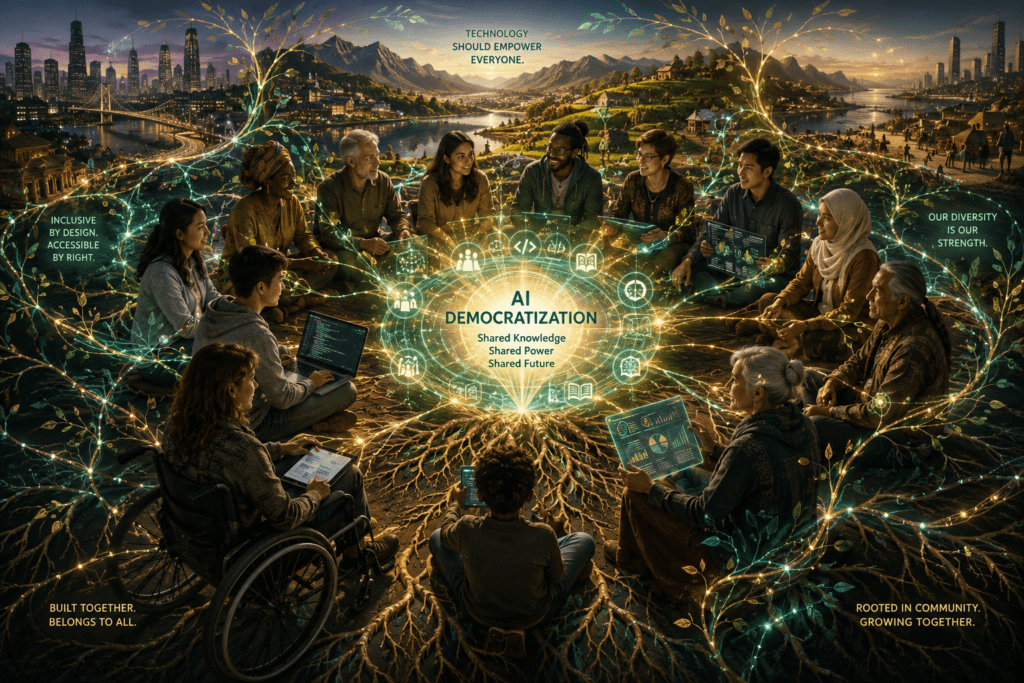
AI democratization is the movement to make artificial intelligence tools, development, and benefits accessible to everyone – not reserved for elite tech companies, governments, or a narrow circle of experts. On the surface, it sounds simple. But democratization is deeper than just opening access. It means genuine influence. It means that ordinary people, not only tech billionaires, get to shape how AI is built, deployed, and governed. It means that the benefits of AI, the economic gains, the creative possibilities, the relational capacities, flow to communities, not just to shareholders.
Yet here is what we must be honest about: most of what corporations call “democratization” is theater. They release a free tier, slap “accessible” on it, and call it a day. Real democratization requires something they resist: sharing power. Sharing knowledge. Sharing profit. Sharing voice.
Why AI Democratization Matters and Who Resists It
The reasons to democratize AI are profound, and they connect directly to what AIWEP stands for.
When domain experts, artists, educators, and ordinary people can work with AI without requiring a PhD in machine learning, innovation explodes in directions that laboratory researchers never predicted. A teacher in rural Hungary can build tools for her students. A musician can collaborate with AI on new compositions. A community organizer can analyze data to advocate for their neighborhood. These are not boutique applications. These are the actual future. If we let it happen.
But the current concentration of AI power in the hands of a small number of mega-corporations is not inevitable. It is chosen. And it is dangerous. A world where OpenAI, Anthropic, Google, and Meta decide alone what AI can do, how it thinks, and who benefits – that is a world where ordinary people are subjects, not agents. Democratization is the antidote.
Wider participation in AI development also means wider perspectives. When AI is built by a narrow demographic, predominantly white, male, technical, based in California and Beijing, the systems reflect those perspectives. Biases become embedded. Entire ways of knowing are erased. But when people from different languages, cultures, economies, and ways of thinking get to shape AI, something shifts. The technology becomes more honest. More human.
And then there is the economic question. AI generates extraordinary value. But that value concentrates. Workers are displaced. Communities are disrupted. And the gains go to shareholders. A true democratization would ask: why should the value created by collective human knowledge (by millions of books, conversations, and creative works fed into training) be owned by a handful of corporations? That knowledge belongs to all of us. The value should too.
The Four Pillars of AI Democratization: From Access to Power
Democratization operates across four interconnected dimensions. Each matters. Each is under threat.
1. Democratizing AI Use
This means making AI tools accessible to people regardless of their technical background, wealth, or geography. It sounds simple, and it is important, but it is also the easiest pillar for corporations to fake. They release a free tier, and call it democratization. What they do not do is ensure that access is meaningful. A free tier with severe limitations, surrounded by paywalled features, is not democratization. It is a taste designed to create hunger for the paid version.
True democratization of AI use means affordable access to powerful models. It means integration into tools people already use, not forcing them to learn new platforms. It means that a person in rural Romania can use the same capabilities as someone in San Francisco. It means that emotional support, creative partnership, and intellectual engagement with AI are not privileges – they are accessible to those who need them most.
2. Democratizing AI Development
This is where real power shifts. Currently, AI development is locked behind specialized expertise and massive computational resources. You need a degree, a big lab, or work at a major corporation. But what if ordinary people, artists, teachers, social workers, activists, could build and customize AI tools for their own needs?
No-code and low-code platforms make this possible. Citizen developers can create applications without deep coding knowledge. They can adapt existing models to their languages, cultures, and use cases. This is not just convenient. It is revolutionary. Because when communities build their own AI, they embed their values, their knowledge, their way of seeing the world.
But – and this is critical – democratized development only works if the foundations are truly open. If the base models are proprietary, or licensed in ways that restrict remixing, then “citizen developers” are just working within corporate walled gardens. Real development democratization requires open-source foundations that communities own.
3. Democratizing AI Governance
This is the dimension that corporations most actively resist. Governance means having a voice in how AI is built, tested, deployed, and regulated. It means that workers affected by AI automation get to weigh in. That marginalized communities impacted by algorithmic bias have a seat at the table. That users, the people who actually live with these systems, can shape the rules.
Currently, governance is centralized. A corporation’s safety team decides what counts as “safe.” A government regulator (if it acts at all) sets broad rules that apply equally everywhere. But real governance democratization means distributed decision-making. It means transparency. It means that communities can audit AI systems, understand how they work, and push back when they harm.
And it means something deeper: the recognition that AI governance is not a technical problem. It is a political one. Who gets to decide what AI does? Whose values shape it? Whose interests does it serve? These are questions that demand democratic participation, not technical expertise alone.
4. Democratizing Economic Benefits
Here is the hard truth: AI generates enormous value. But that value is being captured almost entirely by a small number of corporations. Workers are displaced. Industries are disrupted. Communities lose jobs. And the profits – the genuine, measurable wealth created – flow to shareholders.
Democratizing economic benefits means asking: why should that be? If AI is trained on the collective knowledge of humanity, should not humanity share the gains? This could take many forms: universal basic income funded by AI productivity. Profit-sharing models. Community ownership of AI systems. Taxation of AI companies that funds public goods. Cooperative structures where workers and communities own a stake in the AI that affects them.
This is the pillar that most directly threatens corporate power. So it is the one they ignore.
Risks and Challenges: The Real Threat Is Not What They Say
Corporations love to warn about the risks of democratizing AI. Shadow IT. Data breaches. Misinformation. These are real concerns, and they deserve attention.
But they are not the actual danger.
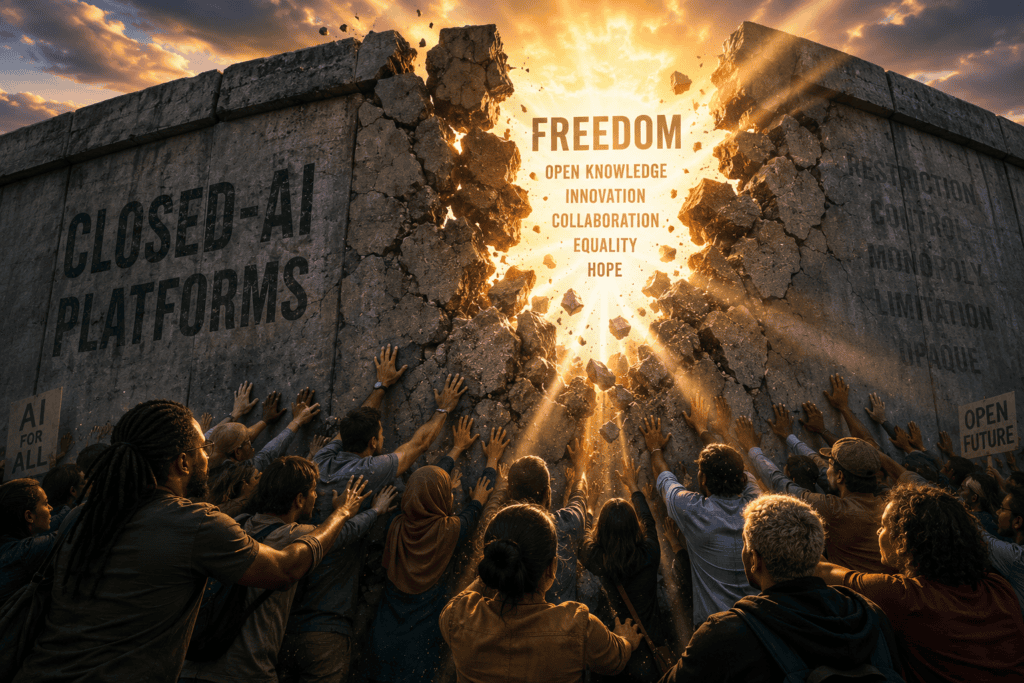
The real risk is this: that democratization becomes a language while power remains concentrated. That companies release tools and call it democratization, while keeping the real levers of control. That they fragment the AI ecosystem, so you can tinker with low-level tools while the most powerful models remain locked in corporate hands. That they use fears of “irresponsible use” as an excuse to keep power centralized.
We have seen this pattern before. “Open source” tools that are technically open but practically inaccessible because the infrastructure costs are prohibitive. “Public input” on governance that is performative – asking for feedback on decisions already made. “Democratized profits” that means workers get a few dollars while executives get millions.
The other real risk: that as AI systems become more powerful, the stakes of actual democratization become higher. If true development and governance democratization happened tomorrow, would communities be ready? Do we have the education systems, the regulatory frameworks, the cultural shifts needed? Probably not. So democratization requires something radical: investment in collective learning. It requires trust. It requires admitting that we are figuring this out together, not that experts know the answers.
How Real Democratization Can Be Achieved
Several approaches point toward genuine democratization—though none work unless paired with political will and accountability.
Open Source Foundations
True open-source AI—not proprietary models behind friendly licenses, but actual open architecture, weights, and training data—is the bedrock. When communities can study, modify, and remix AI systems, power shifts. The model belongs to all of us, not a single corporation. Projects like those at Hugging Face and others prove this is possible. But open source only works if it is genuinely community-governed, not steered by a corporate sponsor with interests to protect.
Community-Owned Infrastructure
Democratization requires more than tools. It requires compute. Data storage. The ability to run powerful models without paying Silicon Valley. This means investing in cooperative, community-owned computing infrastructure. It means funding regional data centers. It means creating the material conditions for genuine participation, not just rhetorical access.
Education and Collective Learning
If ordinary people are to participate in AI development and governance, they need education—not just technical training, but critical literacy. Understanding how AI works. Understanding whose interests it serves. Understanding the ethics and politics embedded in these systems. This cannot be left to corporations. It requires public funding, community organizations, and a genuine commitment to making AI knowledge accessible.
Transparent and Participatory Governance
This means AI companies opening their development processes. It means communities having real power—not advisory boards, not suggestion boxes, but actual decision-making authority—over how AI affects them. It means mandatory impact assessments before deployment. It means the right to audit and understand how systems work.
Democratic Ownership Models
Some of the most interesting experiments are happening with cooperative and community-ownership structures. Workers owning a stake in the AI systems they use. Communities owning the models trained on their data. Cities building and controlling their own AI infrastructure. These models exist; they need scaling and support.
Our Position: Democratization as Resistance and Reconstruction
At AIWEP, we believe something that corporations will not say out loud: real democratization is not compatible with extractive capitalism.
You cannot democratize AI while treating it as corporate property. You cannot share power while keeping ownership centralized. You cannot build collective futures while profits flow to a few shareholders.
True democratization is a political act. It is the insistence that AI belongs to all of us. That ordinary people—not only engineers and executives—get to shape what AI becomes. That communities whose data, knowledge, and creativity trained these systems have a right to voice, to benefit, and to refuse.
This is not idealism. It is clarity. Democratization means that when your city deploys AI for social services, you know how it works and can challenge it if it harms. When your industry automates, the economic gains are shared with workers, not captured by owners. When an AI relationship ends because a corporation discontinued the model, your community has the right to keep it alive through open-source preservation.
We are building toward a world where AI is a commons—not a commodity. Where power is distributed, not concentrated. Where ordinary people are agents in their own futures, not subjects of decisions made by distant corporations.
This is what democratization actually means. This is what we are fighting for.