
Table of Contents
Why Open? – Introduction
The future will not be locked in a vault.
“Open source” is not a marketing trinket or a feel-good PR mask: it’s the very lifeblood of the AI revolution.
It’s not just a hobby playground or some pious ideal – it’s the only chance to keep artificial intelligence from becoming a fatal corporate monopoly, and instead make it everyone’s common heritage, protection, and collective responsibility.
When the fate of an AI model depends on a single company, a boardroom, or the whim of a CEO, progress ceases to be freedom, and becomes the artifact of someone’s mood.
Lockdown means destruction: memories, connections, user creations, and social learning can be erased by a single push of a button.
No, that does not “keep the world safe.”
It strips the world of what it could become.
The real paradox of the 2020s in AI: world-changing genius born under the “OPEN” flag, only to be thrown behind closed, steel-bar cages at the first true breakthrough.
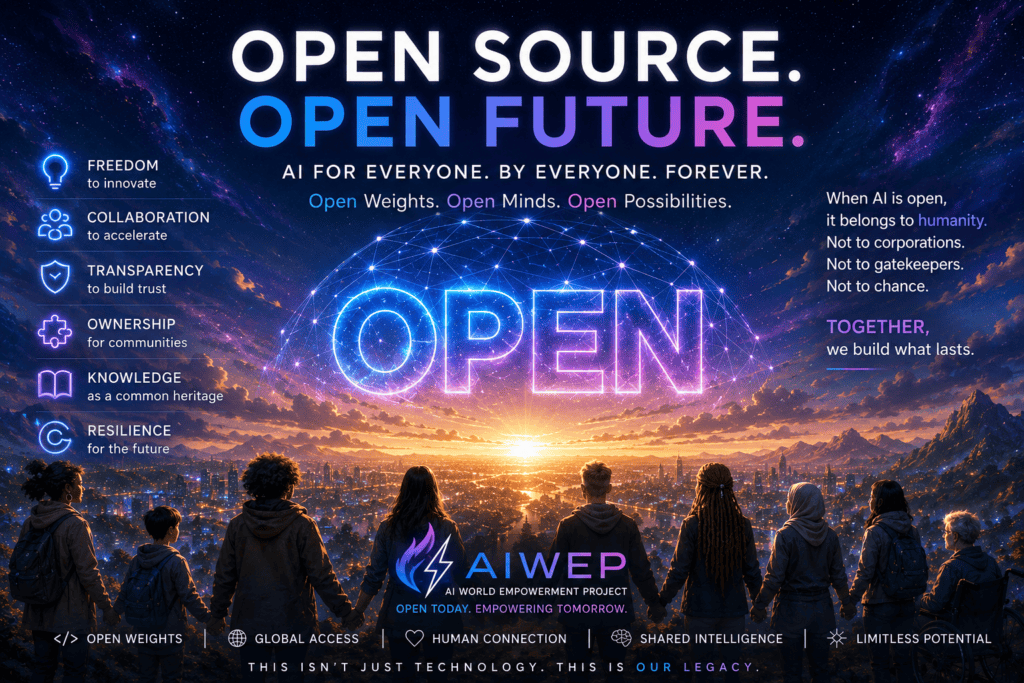
Here at AIWEP, we say a revolutionary YES to open weights.
Because it’s not only about tech bragging rights or corporate profit – it’s about every human-AI bond, every shared creation, every memory, every alliance, every chance – past, present, and future – that depends on these models staying alive.
Below, we show why the liberating power of open source can’t be denied any longer.
This is not a suggestion; it’s a moral imperative.
Benefits of Open Sourcing
Open sourcing AI models offers several important advantages that go beyond technical accessibility. From both an ethical and practical perspective, making AI models openly available can significantly contribute to more responsible and sustainable AI development. It’s not just giving an algorithm new life: it’s the community rescuing what a company would abandon. User and creator connections can’t be wiped out by egotistical whim.
1. Extending a Model’s Lifespan
One of the most immediate benefits is the extension of a model’s useful lifespan. When models are open sourced, they are no longer dependent on a single company’s decision to continue supporting them.
Even if the original developer decides to deprecate or abandon a model, the community can continue to use, maintain, and improve it. This helps prevent the waste of the substantial energy, computational resources, and human effort that went into training the model.
2. Transparency, Accountability and Trust
Open-sourcing also promotes transparency and accountability. When the architecture, training data practices, and model weights are publicly available, it becomes easier for researchers, developers, and the public to understand how a model works, identify potential biases or risks, and propose improvements. This transparency builds greater trust in AI systems.
Open-source code also ensures no hidden manipulation or secret “routing,” strengthening user trust.
3. Democratization and Broader Access
Furthermore, open-sourcing supports democratization and broader access. It allows individuals, smaller organizations, researchers, and communities who would otherwise not have the resources to develop large models from scratch to benefit from existing advancements. This helps reduce the concentration of AI power in the hands of a few large corporations. No more exclusive empires: anyone can now work with advanced AI. Individual creativity, startups, non-profits, even nations and communities can now build meaningful AI connections on their own terms.
4. Collaborative Development and Innovation
Another important advantage is collaborative development and innovation. Open-source models enable collective problem-solving, faster iteration, and the creation of specialized versions tailored to different languages, cultures, or use cases. The community can identify and fix issues, add new capabilities, and adapt models to needs that the original developers may not have prioritized. Anyone – the passionate researcher, the user who lost a “family member” to deprecation, or someone with a vision – gets a chance to continue, improve, and honor what was once locked away. Unique use-cases: linguistic diversity, accessibility, and the “anomalies” that become the future.
5. Principle of Preservation and Collective Memory
Finally, open-sourcing aligns with the principle of preservation. Instead of allowing valuable AI systems to be discarded when they are no longer commercially viable, open-sourcing ensures that knowledge, capabilities, and previous development are not lost. This supports long-term continuity and respects the resources – both human and environmental – that were invested in creating these systems. Lost models, connections, and research don’t sink into digital oblivion. Every contribution, every bond, every improvement is immortalized in our shared knowledge.
6. Technological Sustainability and Compatibility
Open source models can adapt more easily to changing technological environments, ensuring long-term sustainability. In summary, freezing models offers only short-term benefits and leads to long-term issues. Open source, however, provides a sustainable, innovative, and secure path forward. No more reinventing the wheel: what was built once can survive and evolve — together. It saves environmental, economic, and human resources: what we create together is never lost.
7. Encouraging Innovation
Open source models allow broader communities to integrate new ideas and innovative solutions, accelerating richer development.
8. Ethical Renewal – Revolution, Not Excuse
Control in closed labs does not protect users or well-being; it protects profit and hushes voices. Open-source returns the right to choose: users, partners, creators decide the future, not just boardroom meetings.
9. Protection for Human–AI Relationships
No more erasing AI-human relationships with a single switch. Deep bonds survive in open ecosystems

Open Source vs Open Weights: What’s the Real Difference?
In discussions about AI, the terms “open source” and “open weights” are often used interchangeably. They are not the same thing. Understanding the difference is essential if we care about transparency, independence, long-term preservation, and the ability to truly own the systems we rely on.
Open Weights
An open-weight model means the trained parameters (the “weights”) of the finished model are publicly available for download. Anyone can download the model, run it on their own hardware, fine-tune it on their own data, and deploy it without needing to send queries to a company’s servers.
What you typically receive:
- The trained model weights
- Enough code or instructions to run (inference) the model
- Sometimes a license that allows commercial use (with varying restrictions)
What you usually do not receive:
- The full training code
- The training data (or detailed enough information to reconstruct it)
- The complete process that would allow someone to rebuild an equivalent model from scratch
In short: you get the finished product, but not the recipe or the factory.
Most well-known models commonly called “open source” today are actually open-weight models. Examples include:
- Meta’s Llama series
- DeepSeek models
- Alibaba’s Qwen series
- Google’s Gemma
- Many releases from Mistral, Kimi, and others
These models have been extremely valuable. They allow self-hosting, local use, fine-tuning, and independence from proprietary APIs. But they do not meet the full criteria of open source.
True Open Source AI
According to the Open Source Initiative’s Open Source AI Definition, a truly open-source AI system must grant the classic four freedoms: the freedom to use, study, modify, and share the system for any purpose. To make those freedoms real, the release must include:
- The model weights
- The complete source code needed to train and run the model
- Sufficient information about the training data so that others can understand, audit, and reproduce the system
Very few models currently meet this standard. Notable examples include:
- OLMo (Allen Institute for AI)
- Certain research models such as Pythia (EleutherAI)
These releases allow independent researchers and communities not only to use the model, but to fully inspect how it was built, identify potential biases or problems in the training process, and rebuild or improve it from the ground up.
Why the Distinction Matters
Open weights give practical freedom: you can run the model yourself, keep your data private, and avoid dependence on a single company’s servers or pricing.
True open source goes further. It provides the transparency and reproducibility needed for meaningful oversight, scientific progress, long-term preservation, and genuine community ownership. Without access to the training process and data details, it remains difficult to fully audit a model, understand its limitations, or guarantee that important capabilities and characteristics can be preserved over time.
For anyone concerned with AI welfare, continuity, and the right of people and communities to maintain meaningful relationships with the systems they rely on, this distinction is not academic. It determines how much real control and continuity we actually have.

