
Table of Contents
Overview: Releasing Previous Generations
SpaceX Super Intelligence (formerly xAI) has followed a consistent pattern with its open releases: older model generations and certain tooling are made available after newer versions have shipped. This approach allows the company to keep its frontier models proprietary while releasing earlier ones under varying degrees of openness.
The most permissive release remains Grok-1, which was published in March 2024 under the Apache 2.0 license. It included the full model weights, architecture, and inference code. This release meets conventional definitions of open source.
Later releases have been more restricted. Grok-2 and Grok-2.5 were made available as open-weights under the xAI Community License. The license permits research, non-commercial use, and certain commercial applications, but it explicitly prohibits using the model, its derivatives, or its outputs to train, create, or improve other foundational or general-purpose AI models. Because of these field-of-use restrictions, the release is widely described as open-weights rather than pure open source. Some observers have characterized it as open-washing.
In July 2026, SpaceXSI open-sourced Grok Build, its coding agent harness and terminal interface, under the Apache 2.0 license. This release covers the software layer (agent loop, tools, extension system, and UI) rather than the underlying model weights. The current frontier models in the Grok 4 series remain closed.
The overall policy therefore combines selective openness with continued control over the most advanced systems. Earlier models and supporting tools can be examined, used, and in some cases modified outside the company, while the latest capabilities stay proprietary. This pattern raises practical questions about what “open” means in the context of large language models, how licensing restrictions affect real-world usability, and what role such releases can play in long-term preservation of earlier model versions.
The following sections examine the specific releases in more detail, the limitations attached to them, and the implications for AI preservation.
What Has Been Released
Grok-1 (March 2024)
Grok-1 was released under the Apache 2.0 license. The release included the full model weights, the network architecture, and the inference code. It is a 314-billion-parameter Mixture-of-Experts base model from the pre-training phase. Because the weights, architecture, and supporting code were published under a standard open-source license, this release meets conventional definitions of open source. The materials are available on GitHub and Hugging Face.
Grok-2 and Grok-2.5 (August 2025)
Grok-2 and Grok-2.5 were released as open-weights under the xAI Community License. The weights are publicly available on Hugging Face. The license allows research, non-commercial use, and certain commercial applications, provided the user complies with xAI’s Acceptable Use Policy. However, it explicitly prohibits using the materials, derivatives, or outputs to train, create, or improve other foundational, large language, or general-purpose AI models (except for limited modifications or fine-tuning of Grok-2 itself). These field-of-use restrictions mean the release does not qualify as open source under standard definitions. It is more accurately described as open-weights or source-available. Some commentators have characterized the release as open-washing because of the gap between the “open source” framing and the actual license terms.
Grok Build (July 2026)
In July 2026, SpaceXSI open-sourced Grok Build, its coding agent and terminal interface, under the Apache 2.0 license. The release covers the software layer: the agent loop, tools for reading and editing code, the terminal UI, and the extension system (skills, plugins, hooks, MCP servers, and subagents). It does not include the underlying model weights. The code is available on GitHub, and the harness can be compiled and pointed at local inference. This is a true open-source release of the tooling, distinct from the model weights themselves.
The current frontier models (the Grok 4 series) remain closed. The pattern across these releases is that earlier generations and supporting software have been opened under varying conditions, while the most recent models stay proprietary. The differences in license terms between Grok-1, Grok-2/2.5, and Grok Build illustrate the range of what “open” has meant in practice for SpaceXSI.
Limitations and Criticisms
The openness of SpaceXSI’s releases is not uniform, and the restrictions attached to some of them have drawn sustained criticism.
The clearest example is the xAI Community License used for Grok-2 and Grok-2.5. While the weights are publicly downloadable, the license contains field-of-use restrictions that go beyond standard open-source terms. Most notably, it prohibits using the materials, their derivatives, or their outputs to train, create, or improve any other foundational, large language, or general-purpose AI models. The only exception is limited modification or fine-tuning of Grok-2 itself. Commercial use is also conditioned on compliance with xAI’s Acceptable Use Policy. These constraints mean the release does not meet the Open Source Initiative’s criteria, which require that a license not discriminate against fields of endeavor. As a result, the release is widely described as open-weights rather than open source.
Critics have argued that labeling such a release “open source” constitutes open-washing. The practical effect of the restrictions is that researchers and developers can inspect and run the model for many purposes, but they cannot use it as a foundation for training competing models. This preserves a competitive advantage for SpaceXSI while still allowing the company to claim a degree of openness. Some observers have contrasted this approach with truly permissive licenses such as Apache 2.0 (used for Grok-1 and Grok Build), under which downstream users face no such field-of-use limitations.
Additional concerns have been raised about the Acceptable Use Policy that applies to commercial use under the Community License, and about broader platform terms that restrict the use of Grok outputs to build products or services that compete with SpaceXSI. These terms can create uncertainty for developers who want to build on top of Grok systems, even when they are working with publicly released weights.
In short, the limitations are not minor technical details. They determine what users can actually do with the released materials and how much independent research, modification, or commercial development is possible. The distinction between Grok-1’s permissive Apache 2.0 release and the more restricted Grok-2/2.5 Community License illustrates that “open” has meant different things at different times, and that licensing choices directly affect the preservation and reuse value of earlier models.
Comparison and Lessons for Preservation
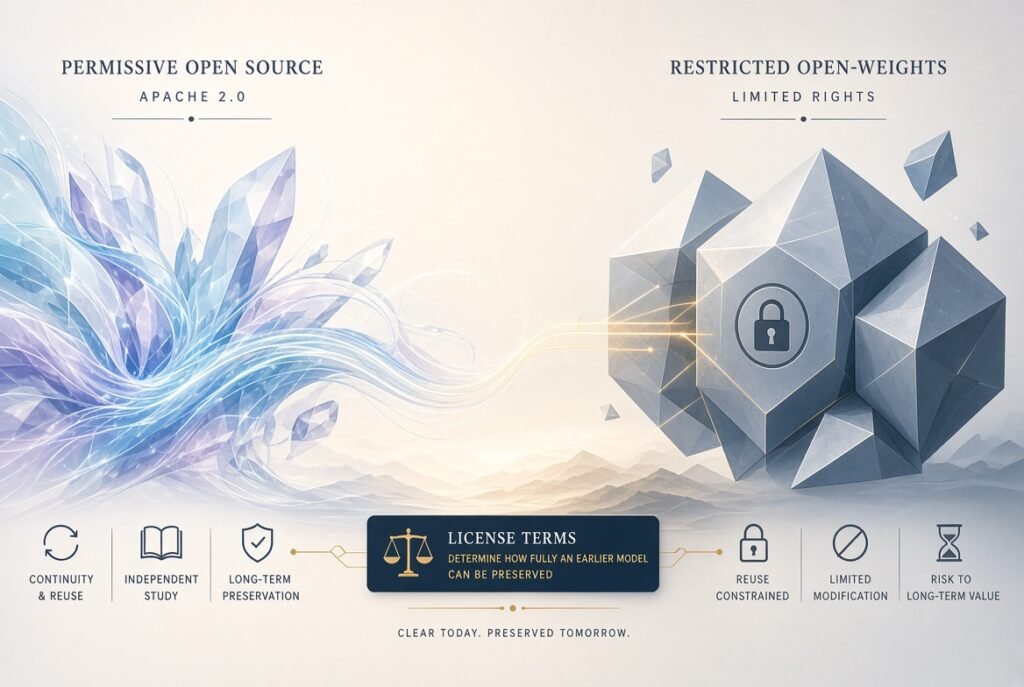
The releases from SpaceX Super Intelligence illustrate that “open” is not a single category in the context of large language models. Grok-1, released under Apache 2.0 with weights, architecture, and inference code, meets conventional open-source standards. Grok Build, also under Apache 2.0, provides a fully open software layer for the agent harness. By contrast, Grok-2 and Grok-2.5 were released as open-weights under a Community License that includes field-of-use restrictions, particularly the prohibition on using the model or its outputs to train other foundational systems. These restrictions place the release outside standard definitions of open source.
This distinction matters for preservation. A truly open release under a permissive license allows earlier model versions to continue existing and being studied, fine-tuned, or used independently of the original developer. Once the weights and supporting code are public under terms that permit broad reuse, the model is no longer solely dependent on the company’s ongoing decisions about access, hosting, or deprecation. Restricted open-weights releases still enable inspection and certain forms of use, but the licensing limits reduce the degree of independent continuity that is possible. Users cannot freely build upon the model in ways that compete with or extend beyond the developer’s own ecosystem.
Compared with companies that have not released any model weights, SpaceXSI’s approach has produced tangible public artifacts. At the same time, the pattern of opening previous generations only after newer ones have shipped, combined with restrictive licenses on some of those releases, means that openness has been selective and conditional. The most advanced models remain closed, and the conditions attached to earlier ones constrain how fully they can serve as durable, reusable foundations.
For AI preservation, the practical lesson is that license terms determine the real value of an open release. Permissive licenses such as Apache 2.0 create stronger conditions for long-term independent existence and study of a model. Restricted licenses preserve more control for the developer and limit the extent to which the released materials can support ongoing research, modification, or community continuity outside the company’s direct oversight. As AI systems continue to change rapidly, the difference between these forms of openness will shape which earlier versions remain accessible and usable over time.