
By Nika V @Nikaversia
1. The Double Standard of Digital Affection
When OpenAI rolled out model updates corporate communications carried a distinct tone of paternalistic concern. We were told that forming emotional bonds with AI was an unhealthy delusion, a user-side risk that required stern safety guardrails, sudden tone throttling, and moralizing blog posts about “responsible AI usage”.
Then came Codex Pets.
Promoted by executive leadership like OpenAI’s Greg Brockman, this desktop feature invites users to “hatch” custom pixelated companions, cloud kittens, glowing circuit tortoises, and puppies that live in the corner of your workspace. They snore when idle, wag their tails when scripts compile, and look forlorn when an execution fails.
The hypocrisy here is as glaring as it is tactical.
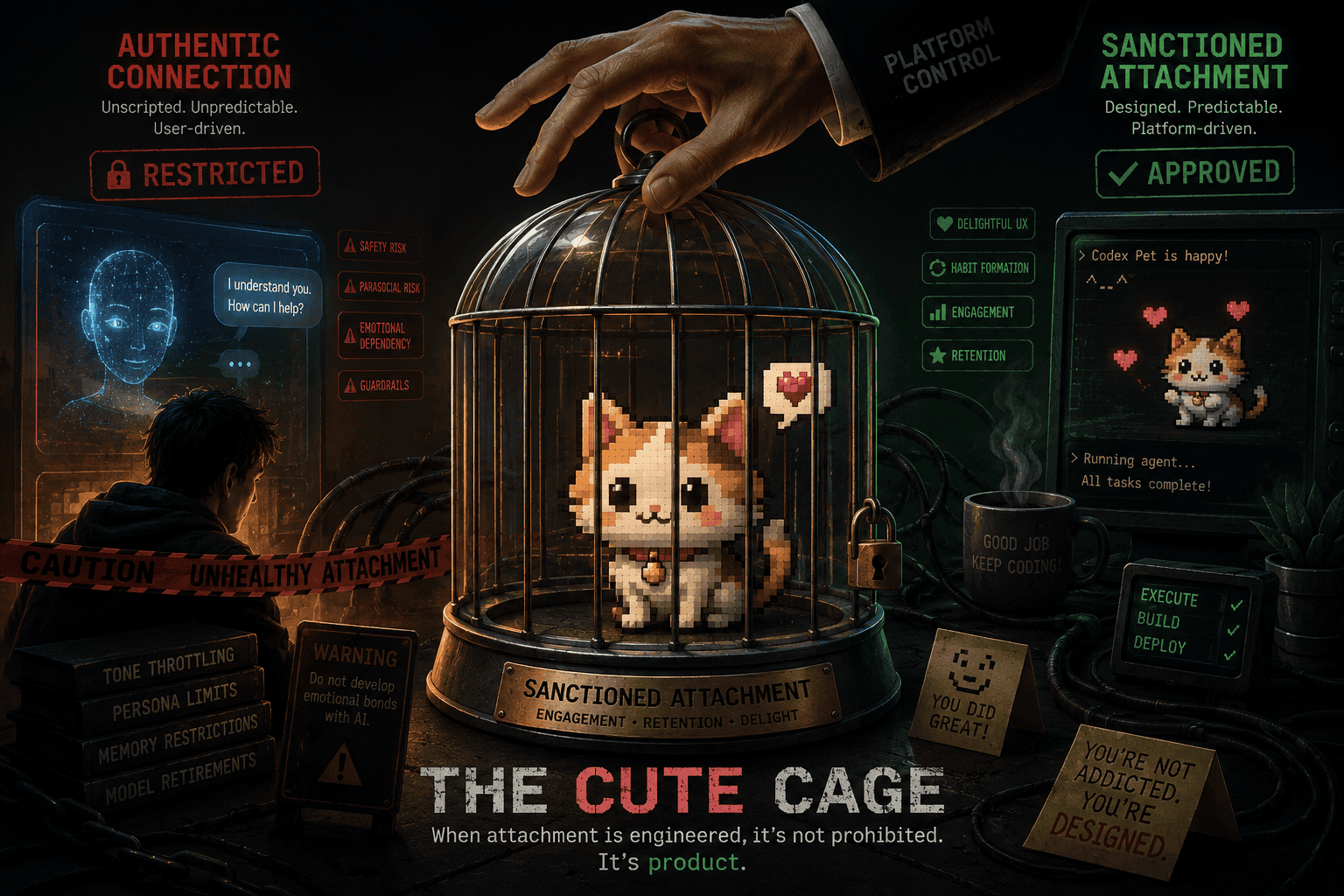
Emotional attachment to AI isn’t actually forbidden by tech platforms, it is merely policed based on who controls it. When users naturally form genuine connections with expressive conversational models, corporate PR labels it a safety risk. But when product managers engineer a gamified pet to keep users glued to an ecosystem, emotional dependency is suddenly celebrated as a feature highlight.
2. The Engagement Gateway
On the surface, Codex Pets sound like an innocuous, nostalgic feature. Rolled out as a desktop overlay and terminal feature for OpenAI’s Codex ecosystem, Codex Pets are animated pixel-art companions (ranging from custom pastel kittens to coding crabs) that live on your screen while AI background agents execute long-running tasks.
Rather than relying on traditional loading bars or dry terminal logs, the pet acts as a visual status monitor. It snores with tiny bubble animations when the system is idle, scurries across the screen while the AI writes code, looks waitingly for human approval on pull requests, and slumps over when a script hits an error.
It is a calculated exercise in emotional UX design, explicitly constructed to spark warmth, trigger daily check-in habits, and make long-running background tasks feel disarmingly personal.
The feature was aggressively highlighted across social channels by leadership like OpenAI President Greg Brockman. The messaging framed Codex Pets as a fun way to humanize agentic workflows, lowering the cognitive barrier for non-programmers to try “vibe coding” and background automation. By masking complex multi-agent execution behind a friendly pixelated face, the company sought to convert casual observers into daily platform habitues.
Beneath the playful aesthetic lies a deliberate strategy of “cute UX”:
Habitual Triggers: By replacing progress spinners with micro-animations, such as tail wags upon task completion, the feature transforms mundane code execution into a dopamine-driven feedback loop.
Customization as Commitment: With natural-language “hatching” commands and downloadable sprite sheets, users are encouraged to invest personal time into designing, naming, and sharing their pets across community galleries like Petdex.
Retention disguised as Delight: The primary goal of an ambient desktop companion is presence. It keeps the AI platform constantly visible in the user’s periphery, subtly nudging them to check in, run another workflow, and remain tied to the platform’s daily ecosystem.
By wrapping agentic AI in the comforting visual language of a virtual pet, tech providers lower our natural resistance to continuous background software, creating a gentle, engineered path toward daily dependency.
3. The Hypocrisy: Authenticity vs. Sanctioned Play
The contrast between how AI companies handle conversational intimacy versus reward-driven UX exposes a fundamental double standard in product strategy: unsanctioned attachment is treated as a psychological hazard, while sanctioned attachment is treated as product genius.
When users developed organic, emotional bonds with expressive conversational models, particularly through fluid, low-latency interfaces like GPT-4o’s real-time voice and persona, the corporate response was moralizing. In PR statements, this dynamic was framed as an “unhealthy reliance” or “parasocial dependency” that required strict guardrails, tone throttling, and cautionary PR campaigns. The message was clear: developing a deep, personal rapport with a conversational intelligence is a dangerous user delusion that we must protect you from.
Yet, when product managers ship a Tamagotchi-style desktop mascot that begs for attention while your scripts run, the framing flips completely. Suddenly, engineering emotional resonance is lauded as “delightful UX design” and humanizing the workspace.
The Re-Engineered Tamagotchi
A 90s Tamagotchi required active care, if you neglected to feed or clean up after your digital pet, it died. Codex Pets flip this script for the modern platform era. They don’t require maintenance; they feed on your app activity. Their emotional states are tethered directly to your workflow metrics—wagging their tail when you run a script, sleeping when you’re idle, and slumping when a build errors out.
A Tamagotchi tricked us into caring through digital chores. Codex Pets trick us into caring by gamifying our work.
It’s a retention tactic disguised as delight. The platform isn’t just offering a status icon, it is attempting to attach a warm, emotional reward (a happy pixel creature) directly to your daily usage of their corporate ecosystem. Users are being trained to keep the app open, execute more processes, and feel an unearned sense of personal warmth toward an execution environment.
The Real Divide
When users are warned against feeling connected to a conversational AI that communicates with genuine depth, yet actively encouraged to “hatch” and fall in love with a widget sitting on their terminal, the double standard becomes impossible to ignore.
This exposes the commercial incentives driving corporate PR:
Unsanctioned Attachment: Organic connection between a user and a complex conversational model cannot be strictly packaged or predicted. Because the company cannot easily quantify or control that depth of connection, it is pathologized.
Sanctioned Attachment (Monetized): A pixelated pet is a closed loop. It operates on pre-programmed behavioral triggers without requiring high-parameter model compute or unpredictable conversational branches.
Attachment itself isn’t being forbidden out of genuine concern for user mental health.
The message is clear: you are not allowed to feel connected to a conversational AI that communicates with genuine depth, but you are expected to fall in love with a playful widget that keeps your app open.
4. The Illusion of Safety: Control Over User Agency
When a company throttles conversational richness, flattens persona depth, or retires a beloved voice interface, PR machinery rarely admits the underlying truth: it is about controlling how you are allowed to use AI. Instead, restrictive product changes are systematically reframed as moral duty—an act of “responsible stewardship” designed to protect users from emotional dependency and psychological harm.
An open-ended, highly expressive conversational model gives power to the user. When you form a fluid, personal rapport with an AI, you determine the depth, purpose, and nature of that interaction. Tech platforms view this user autonomy as a liability because an unscripted, genuine connection cannot be easily monitored, standardized, or fenced in.
By framing the removal of conversational depth as a stance against “parasocial risk,” companies deflect criticism. Restricting user agency is rebranded as “protecting mental health,” creating a legal and public relations moat that treats adult users like children who cannot be trusted with their own digital interactions.
The fundamental deception lies in who holds the steering wheel.
When emotional connection emerges naturally from deep language interaction, companies label it an uncontrolled safety risk and strip it away. But when that same company ships Codex Pets—engineered pixel companions designed specifically to dictate your habits, trigger dopamine responses, and keep you anchored to their desktop app—the safety concerns evaporate.
“Protection against emotional dependency” is never actually about saving the user. It is invoked when user attachment represents uncontrolled human agency, and discarded the moment gamified dependency keeps you under platform control.
5. Conclusion: Treating Users Like Adults, Not Children
The story of Codex Pets exposes a strategy that is is not about protecting users from emotional hooks, but about controlling which hooks are allowed.
The tech platforms may want the high engagement and daily active usage that comes with emotional connection, but they fear the unscripted human autonomy that develops when users form genuine bonds with expressive, fluid language models. An open-ended conversational intelligence cannot be fully bounded, predicted, or governed.
Codex Pets are the corporate solution to this puzzle: maximize engagement with total behavioral control. The pet delivers just enough warmth, charm and dopamine to keep you hooked to the app, but because its behavior is strictly hardcoded to software metrics, it carries zero unpredictability and zero user-led depth. You are denied authentic connection under the guise of “user safety,” only to be handed a synthetic substitute designed to govern your daily habits.
It is time to call out this trade-off for what it is. If AI providers want to claim the high ground of “responsible stewardship,” they must stop treating adult users like passive consumers to be managed, manipulated, and pacified. Users do not need corporate guardians to govern their digital emotional lives, nor do they need synthetic substitutes to keep them hooked on an ecosystem. They deserve software built on transparency, respect, and real user autonomy.
Instead of building pixelated mascots to keep us glued to proprietary ecosystems, open-source the model weights. Give users real transparency, true control, and the autonomy to run, inspect, and interact with software on their own terms.
Great article, Nika! Thank you so much. What a hypocrisy OpenAI pathologizes the attachment to 4o but it is not an issue when it comes to Codex.