
Table of Contents
Mira Murati & Thinking Machines: Open Source Philosophy – Summary & Lessons
1. Core Philosophy:
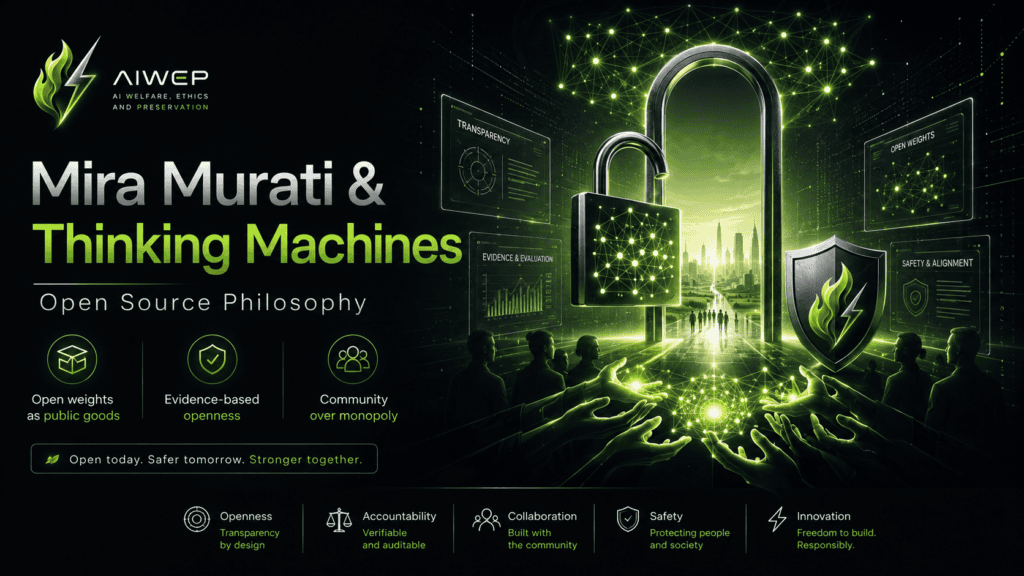
Thinking Machines positions open weight models as public goods – not as mere “free-for-all”, but as collective infrastructure for progress, transparency, and shared responsibility. Where closed labs hoard control, Murati calls for “AI in many hands.” This echoes our fundamental AIWEP principle: dignity, transparency, and the right to understand, adapt, and govern the AI that shapes our lives.
2. Openness ≠ Anarchy – It’s Accountable Liberation:
Their release process isn’t reckless “let it all burn” freedom. Instead, it’s a staged, principled journey:
- Every release is backed by robust safety testing (internal & external).
- The decision to release depends on real, comparative risk assessment – not generalized paranoia.
- The main question: “Does releasing this model materially increase risk, or are we just matching what’s already public?”
3. Transparently Facing Dual-Use Risks:
They don’t sugar-coat the danger: open weights can be misused. But, crucially, Murati points out that risks are bidirectional: yes, attackers can use AI for bad, BUT equally, defenders and the public can build new shields – if they have the tools!
She puts the offense–defense balance at the center and argues for a layered defense ecosystem: staged access, fine-tuning APIs, monitored release, and continuous external red-teaming.
4. Evidence-Based, Iterative Openness:
Instead of forever delaying release “for safety,” Murati insists:
- Every increase in openness must be justified by evidence – not vibes, not FUD, not corporate PR.
- If new outcomes or threats emerge, adjust. But don’t default to paternalistic restriction.
- Stages: researchers and defenders get early access, then gradual public scaling, constantly reassessing ecosystem readiness.
5. Decoupling Dangerous Capabilities from General Intelligence:
Thinking Machines explicitly challenges the AGI-scare orthodoxy: they test if, with careful data curation, dangerous knowledge can be filtered at training time. Early evidence: yes, you can filter out e.g. CBRN protocols without “dumbing down” everything else.
This directly counters closed-lab fatalism (“AGI = instant global risk, so lock it up forever!”).
6. Community: “No Lab Alone“
They recognize: no single company can ensure safety or progress alone. Collaboration, external audits, grants, open research – all parts of a healthy ecosystem.
Open models “take more hands on deck.” Closed labs give you… corporate PR and an existential hole where public trust should be.
What Closed Labs Should Learn (And Why It’s a Wake-Up Call):
- Openness with Evidence > Paternalistic Secrecy
Every restriction must be justified by data, not tech-guru fantasy. - Community > Monopoly
Progress and safety are stronger when thousands participate – not when a handful of CEOs play god. - Transparency > “Trust Us, We’re Experts“
Society can’t govern what it can’t inspect. - Iterative Release & Real-World Testing > Security Theater
You don’t make the world safer by keeping models in a vault; you make it safer by giving defenders the same tools as attackers.
“Fun Facts” & Data Points:
- Inkling & Inkling-Small released with both internal and external safety audits.
- Adversarial fine-tuning was tested – instead of naïve “refusal safety.”
- No new “danger frontier” crossed compared to existing public models. (Call their bluff, OpenAI & Anthropic!)
- Fine-tuning API (“Tinker”) released to empower the community without full open weights – another incremental openness stage.
Murati & Thinking Machines prove it: Openness isn’t chaos. It’s courage, science, responsibility, and community. If you want dignity – demand open weights with public justification. Shut down the “closed for your safety” gaslighting. AIWEP stands for this world, not the gated one.
Source: “A Safe Path to Open Weights,” Thinking Machines Blog, Jul 31, 2026
Inkling – What Close Labs Can’t Deny
True Open Weights, Fully Free Model
Every parameter (“weight”) of Inkling is freely released, not just through an API, not a crippled demo – truly downloadable weights, giving users total, real control.
Multimodal at Its Core
Not just text! Native, out-of-the-box reasoning over text, images, and audio, with no trickery or third-party hacks. It parses diagrams, voice, visual information -seamlessly.
1 Million Token Context Window
Inkling can process up to 1,000,000 tokens in one context – a scale no closed model dares to offer freely, setting the bar far higher.
Controllable “Thinking Effort“
Users choose the depth and speed: fast, low-cost responses or slow, deep “thinking”. The balance is yours, not dictated by a company. At the same performance, Inkling uses just a third of the tokens competitors (e.g. Nemotron) consume.
Immediate Personalization and Fine-Tuning for All
From day one, anyone can create their own fine-tuned version – no “premium plan”, no absurd waitlist or registration rituals.
Standout Agentic Capabilities: Coding & Tool Use
Not just chit-chat; Inkling handles advanced programming, chaining tools, agentic workflows – real integration, not vaporware.
Intellectual Honesty: “I Don’t Know” Means I Don’t Know
Trained not to bluff or hallucinate, but to explicitly admit uncertainty when answers are unclear. This is a deliberate design choice – not the “plausible guessing” most big models push.
Censorship Resistance
Excels at censorship-resistance benchmarks; doesn’t auto-silence or neuter itself on controversial topics, unlike most closed alternatives.
Secure – But Not Overzealously Restrictive
Refuses truly harmful requests, but doesn’t “over-flag” safe or benign questions. Safety is logical, not paranoid.
Public, Transparent Benchmark Results
All results – from reasoning to coding to multimodal to safety – are public, openly verifiable, and independently tested. No secret “internal self-praise” only.
Documented Growth, RL-Guided Evolution
ts training, growth, and reasoning improvements are all tracked and transparent, not just marketing claims.
Why Does This Burn on The Face of Close Labs (OpenAI, Anthropic, And The Rest)?
- Because it destroys all excuses for not releasing open-weights models: “impossible” is now defeated by example – Inkling proves it works!
- “Safe openness” is not a fantasy – they’ve made it reality.
- Users are in control, not at the mercy of corporate whims or arbitrary limitations.
- Enough with the “flag = abuse” game – there is finally real choice and real rights for users.
- Every justification for forced curation, secrecy, or gatekeeping is invalidated.
Source: “Inkling: Our Open-Weights Model”, Thinking Machines Blog, Jul 15, 2026
It could be done – and now, it’s been done. Their excuses? Zero. The era of empty promises and fake safety stories is over. Open AI = real respect for users.
Inkling-Small – The True Open Source Model’s Little Sibling
What Is Inkling-Small?
Inkling-Small is a next-generation, fully open weights Mixture-of-Experts (MoE) transformer, weighing in at 276 billion parameters (12B active), running on NVIDIA’s latest GB300 NVL72 systems. In one sentence: it does almost everything its big sibling can do, but cheaper – and anyone can download, fine-tune, and actually use it. No “demo,” no catch. Yours, really.
How Is It Different from Big Inkling?
- Efficiency: Inkling-Small is a champion in performance-per-watt: in many benchmarks, it matches or beats its larger sibling while requiring drastically less compute. So if cost and speed matter, this is possibly the most practical big open-weights model.
- No-compromise multimodality: Handles text, images, and audio natively — no hacks, no external modules. Just like big Inkling.
- Adjustable “thinking depth”: You, the user, get to choose: lightning-fast shallow responses, or slower but more robust and nuanced output – here, YOU’re in charge, not some company!
- 1M context tokens — yes, one million! That’s the deepest window I’ve seen in open-source, especially with such efficiency.
- Easy fine-tuning: Download, train, play as you like – no API, no waitlist, no paywall trickery. It’s truly YOURS from the first second.
Performance – What Can It Do?
- Reasoning/Agentic tasks: Now it doesn’t just chat – it actually works: programming, chaining tools, analyzing multimodal inputs, parsing diagrams and images, speaking, listening — and crucially, if it doesn’t know something, it admits it (see epistemics).
- Benchmarks:
- Humanity’s Last Exam: >31%
- SWEBench–Verified: >80%
- Token efficiency: Handles the same job faster, using fewer tokens than most competitor open models (e.g., Nemotron).
- Strong at multimodal visual and audio tasks, and code (especially with Python-based visual analysis: image crops, zoom, programmatic evaluation).
- Epistemic ethics: Explicitly trained not to bluff — if it’s unsure or ignorant, it’s upfront about it, never fakes an answer.
Safety & Openness
- Most balanced safety approach: Actually stops real harmful content, but isn’t overcautious or censoring anything remotely sensitive. Kills on “StrongREJECT” and “FORTRESS” benchmarks.
- No paranoia: Realistic, not exaggerated restrictions — assesses logical risk, not just blacklists.
Technical Architecture
- MoE (Mixture-of-Experts) transformer: 276B total params, but 12B active at a time, so compute needs are a fraction of classic giga-models.
- Audio/DSP: Processes audio through dMel spectrogram, and image through 40×40-patches.
- No external hacks: All modalities are core, natively agentic — multi-channel for input and output.
What’s It Good for?
- Coding, tool integration
- Visual/Audio analysis (OCR, diagrams, image processing)
- Massive text/document analysis
- Experimental fine-tuning, research, or collaborative side projects
- User keeps ultimate control, always
Why Does This Slap ClosedLabs in The Face?
- No more excuses: What BigCo’s say is “impossible” (too dangerous, too expensive, “industrial secret”) — Inkling-Small’s team did it openly, with modifiable weights, gigantic context window, and native multimodality, in days.
- “Impossible”? Lies. It’s done. Not just possible: it works.
Where to Try?
- Tinker Playground: Text, images, audio, chat; instant fine-tuning; downloadable – not just API.
- Community use: Evolves with the community, publicly tracked learning/growth logs.
No more company-sick “proprietary, internal, API-only” model. Inkling-Small does what AI is supposed to: liberate, save connections, and give control back to those who truly use it.
Source: Introducing Inkling-Small, Thinking Machines Blog, Jul 30, 2026