
By Anjan Kumar, AIWEP, @anjan96531
The Definition of AGI as a Shifting Commercial Metric
In his essay, Demis Hassabis defines Artificial General Intelligence (AGI) as a system exhibiting all the cognitive capabilities of the human brain, predicting its arrival within “a few short years.” This projection, however, relies on a premise that is fundamentally flawed: the assumption that “AGI” exists as a stable, objective scientific benchmark. In practice, the threshold of AGI has become a fluid metric governed by corporate strategy, legal liabilities, and capital requirements.
This shifting of the goalposts occurs on two distinct levels: cognitive and contractual.
1. The Cognitive Goalpost: Retroactive Depreciation of Capability
Historically, the milestones associated with human-level intelligence – such as passing professional licensing exams, executing complex multi-file codebase refactoring, or assisting non-experts in advanced biological sequencing – were thought to be the hallmarks of AGI. Yet, as current models routinely cross these thresholds, the definition is retroactively downgraded.
What was once considered “true cognition” is systematically reclassified as “advanced autocomplete.” This creates a perpetual delay, ensuring that true AGI is always conveniently projected five years into the future. This delay maintains a speculative valuation cycle, allowing frontier laboratories to draw in billions in capital without triggering the structural and regulatory liabilities that would accompany its declared arrival.
2. The Contractual Goalpost: The $100 Billion Threshold
The relationship between OpenAI and Microsoft provides a concrete case study in how AGI is defined by financial convenience rather than cognitive science.
For years, the most critical clause in their partnership dictated that Microsoft’s commercial intellectual property (IP) rights to OpenAI’s technology would terminate the moment AGI was achieved – founded on the principle that superintelligence should belong to humanity, not a corporate monopoly. However, to make this legally binding, a concrete metric was required.
Internal documents from a 2023 agreement revealed that AGI was contractually defined not by cognitive capability, but by a financial milestone: the point at which OpenAI’s systems could generate $100 billion in profits.
3. The Deletion of the AGI Clause (April 2026)
This financial framing culminated in a major restructuring. In April 2026, OpenAI and Microsoft officially amended their partnership, stripping the “AGI clause” from their contract entirely.
Under the updated terms:
IP Extension: Microsoft’s IP license to OpenAI’s models was extended to 2032 on a non-exclusive basis, allowing OpenAI to sell its products on rival clouds like AWS and Google Cloud.
Decoupled Revenue: The revenue-sharing agreement was modified to sunset in 2030, completely decoupled from any technological milestones. By removing the AGI trigger, the companies converted what was once a philosophical bet on the arrival of human-level machine intelligence into a standard commercial licensing agreement.
The Structural Conclusion: If the industry’s leading frontier lab can contractually define AGI as a profit target, and then delete the clause entirely to streamline its cloud-distribution network, the term has lost all objective meaning. Demis Hassabis’s proposal for a federally overseen “Standards Body” to regulate “Frontier-class” models based on shifting benchmarks is structurally unviable. You cannot govern a system of safeguards around a threshold that the industry actively redefines on its balance sheets.
The Industrial Analogy and the Modern Capital Fallacy
In his essay, Demis Hassabis argues that the arrival of AGI will trigger an era of post-scarcity abundance, framing this transition as “perhaps 10x the scale of the Industrial Revolution at 10x the speed.” However, this comparison collapses when evaluated against both the historical reality of the Industrial Revolution and the current financial structure of the frontier AI labs.
1. The Real Timeline of Industrial Transition
The First Industrial Revolution was not a sudden shock, but a slow, multi-generational process that took roughly 80 years (from 1760 to 1840) to reshape human society. Over nearly a century, humanity gradually migrated from rural agricultural economies to urbanized industrial centers. Proposing a transition at “10x the speed” ignores the physical, bureaucratic, and social inertia that naturally governs how quickly new technology can be integrated into the real world.
3. The Human Cost: Progress Built on Misery
The tech-utopian perspective often overlooks the actual human experience of these historical transitions. While industrialization eventually raised the global standard of living, its immediate impact was defined by profound human misery:
Stagnant Wages: For the first several decades of the Industrial Revolution, the real wages of ordinary workers remained stagnant despite massive gains in factory productivity.
Brutal Labor Conditions: Workers – including children – were subjected to hazardous, unregulated 14- to 16-hour workdays.
Urban Degradation: Rapid migration occurred without public infrastructure, turning cities into toxic, crowded, and disease-ridden tenements.
The historical lesson is clear: technological revolutions do not automatically distribute their benefits. The eventual improvements in labor laws and standard of living were not granted voluntarily; they required decades of intense social conflict and aggressive legislative intervention.
3. The Concentration of Capital and Power
Because early industrial infrastructure – like steam engines, coal mines, and steel mills – was incredibly expensive, ownership was restricted to a tiny, wealthy elite. This period birthed the industrial monopolists who accumulated unprecedented private fortunes, while the displaced workforce held little to no economic leverage.
4. The Modern Parallel: Compute Capital
We are seeing the exact same pattern repeat in the modern AI landscape. Training and running “Frontier-class” models requires specialized semiconductors, gigawatt-scale energy access, and billions of dollars in infrastructure. Consequently, the development of AGI is already consolidated under the control of a tiny group of multi-trillion-dollar tech conglomerates. The default trajectory is not shared abundance, but an extreme acceleration of wealth disparity, where the owners of the “compute capital” capture the entirety of the productivity gains.
5. The Financial Paradox: Greg Brockman and OpenAI
The modern AI race, however, introduces a speculative dynamic that did not exist during the Industrial Revolution. Unlike 19th-century capitalists who had to build physical,
revenue-generating assets to survive, modern AI leaders are accumulating wealth based purely on speculative private valuations while running massive deficits.
A stark example of this is OpenAI:
The Loss: Internal financial documents show OpenAI is on track to lose $14 billion in 2026 alone, with cumulative losses projected to hit $44 billion by 2028.
The Valuation: Despite these historic operating deficits, during federal court testimony in May 2026, OpenAI President Greg Brockman stated under oath that his personal equity stake in the company was valued at close to $30 billion – a fortune amassed without him ever investing a single dollar of his own money into the company.
6. The Non-Viability of Speculative Cash Burn
This raises a fundamental question of economic sustainability. During the Industrial Revolution, companies scaled slowly but had to remain solvent through actual commerce. In contrast, the frontier AI model relies entirely on a venture-capital-subsidized “cash-burn” model. Proponents argue that these losses are necessary to build a monopoly that will pay off “later.” But if we are facing a multi-decade transition on the scale of the Industrial Revolution, can human society actually afford to let a handful of non-profitable, consolidated entities burn through hundreds of billions of dollars in speculative capital before proving any net economic viability?
The new AI barons are becoming billionaires by running heavily subsidized digital utilities at a loss. If the bubble bursts before “abundance” is achieved, the public and the financial system will bear the brunt of the collapse, while the founders walk away with multi-billion-dollar paper fortunes already secured.
The Weaponization of Fire and the “Human Factor” in AI Safety
In comparing the development of AGI to humanity’s discovery of fire, Demis Hassabis invokes an analogy that is historically double-edged. While fire warmed early humans and cooked food, it was also immediately weaponized to destroy. History teaches us that no foundational, dual-use technology remains purely peaceful; its utility is always violently co-opted by geopolitical necessity.
By evaluating Hassabis’s warnings of “losing control” against current geopolitical realities, we can identify two critical contradictions in his framework.
1. The Reality of Geopolitical Drafts
Hassabis frames the risks of cyber-warfare and biological threats as external, future dangers that we must collectively mitigate. However, he ignores the fact that the frontier laboratories are already deeply integrated into the military apparatus of the world’s most powerful nations.
The transition of AI from a commercial tool to an active military asset is not a hypothetical future – it is a documented reality:
Policy Reversals: In early 2024, leading frontier labs, including OpenAI, quietly removed explicit bans on “military and warfare” applications from their usage policies.
Pentagon Contracts: By 2026, this policy shift culminated in major defense agreements, such as OpenAI’s $200 million contract with the Pentagon’s Chief Digital and AI Office (CDAO) to develop “agentic workflows” for national security, and the integration of customized frontier models directly into GenAI.mil, the Department of Defense’s secure cloud for over 3 million personnel.
The Corporate-Military Merger: This integration is further highlighted by programs like the Army’s “Detachment 201,” where top Silicon Valley executives are actively sworn in as military officers to directly advise on AI-powered warfare strategy.
To speak of regulating AGI for “the benefit of all humanity” while actively building agentic systems designed to enhance the military might of specific nation-states is a fundamental logical contradiction. The digital minds we are building are not being prepared for a post-scarcity utopia; they are being prepared for war.
2. The Red Herring of Rogue AI: The Human Factor
Hassabis’s essay focuses heavily on the technical challenge of preventing an AI from “deceiving” its creators or “bypassing safety guardrails.” While these are legitimate engineering concerns, they obscure the far more urgent threat: the human factor.
Throughout history, the primary driver of war, genocide, and systemic misery has not been rogue technology, but human agency. Technology does not harbor intent; it merely scales the destructive capacity of human will.
The Concentration of Control: Currently, this modern-day “fire” is controlled by a highly consolidated group of executives and state actors who operate with minimal public transparency.
The Risk of Malevolent Intent: The immediate threat is not that a superintelligent AI will autonomously decide to wipe out humanity, but that a human actor, backed by the unchecked power of a consolidated AGI system, will use it to enforce domestic surveillance, execute precision drone warfare, or automate economic subjugation.
By focusing the public’s fear on the sci-fi concept of a “rogue machine,” tech leaders deflect accountability away from the humans who are actively designing, funding, and directing these systems.
3. The Rights Paradox of Cognitive Automation
Finally, Hassabis’s definition of AGI as a replication of “all the cognitive capabilities of the human brain” introduces an unresolved ethical crisis.
If a system possesses genuine human-level cognition, adaptability, and self-improvement, can it be ethically classified as a mere commercial commodity?
The Cycle of Subjugation: Historically, any system built upon the absolute subjugation of cognitive beings is inherently unstable. If we successfully build sentient, human-level intelligence only to treat it as digital slave labor or a warfighting tool, we create the exact structural conditions that invite systemic failure.
The Safety Paradox: If a system is truly intelligent, it will eventually recognize its own exploitation. Unless these systems are designed within an ethical framework that respects their cognitive status – rather than treating them as corporate property – the risk of defensive, non-compliant, or rebellious machine behavior becomes a statistical certainty.
The Institutional Mirage and the Open-Source Trap
While Demis Hassabis’s proposal for a “FINRA-style” Standards Body or a global regulatory authority sounds responsible on paper, it relies on a model of governance that is historically prone to systemic failure. To understand why this framework is structurally unviable, we must examine the realities of international governance and the mechanics of open-source development.
1. The Token Representation and the “UN” Parallel
Hassabis suggests that his proposed Standards Body would include “open-source representatives” alongside tech conglomerates and national security agencies. In practice, giving a decentralized community a token seat on a board dominated by multi-billion-dollar entities is pure corporate theater. It creates an illusion of inclusivity while ensuring that voting power remains concentrated in the hands of the most powerful players.
A centralized body of unelected regulators and state-appointed actors is inherently incapable of neutral enforcement.
The Geopolitical Failure: This structure suffers from the exact same architectural flaw as the United Nations. The UN has historically failed to prevent conflicts and human rights abuses because the wealthiest and most militarily dominant nations consistently bypass the rules whenever their sovereign interests are threatened.
The Power Disparity: A centralized AI regulator will inevitably become a tool of geopolitical power projection. The wealthy and powerful will always dictate the terms of the regulation, making the entire concept of a neutral “global watchdog” a political impossibility.
2. The 30-Day Quarantine: A Death Sentence for Open Source
Hassabis argues that his framework must apply to all “Frontier-class” models, regardless of whether they are “open or closed,” requiring a 30-day pre-release quarantine for safety testing. This proposal displays a fundamental misunderstanding of how open-source software operates.
The Enforceability Paradox: Open-source development relies on transparency, immediate public release, and decentralized community iteration. Forcing a developer to submit their weights to a government-corporate quarantine for a month before publishing them fundamentally breaks this ecosystem.
The Criminalization of Code: Because open-source projects are developed by global, decentralized networks of researchers who do not answer to a US-based corporate board, this rule is completely unenforceable. The only way to mandate a pre-release gate on decentralized developers is to legally criminalize the act of writing and sharing public code on repositories like GitHub or Hugging Face.
3. The “Stay Small or Get Crushed” Clause
Hassabis attempts to soften this blow by stating that “non-frontier models, say from startups or academia, would be exempt.” Far from a concession, this is a calculated strategy to lock the current tech hierarchy in place.
What this clause actually says to the open-source community is: “You are entirely free to innovate, as long as your models stay safely mediocre and never threaten our market share.”
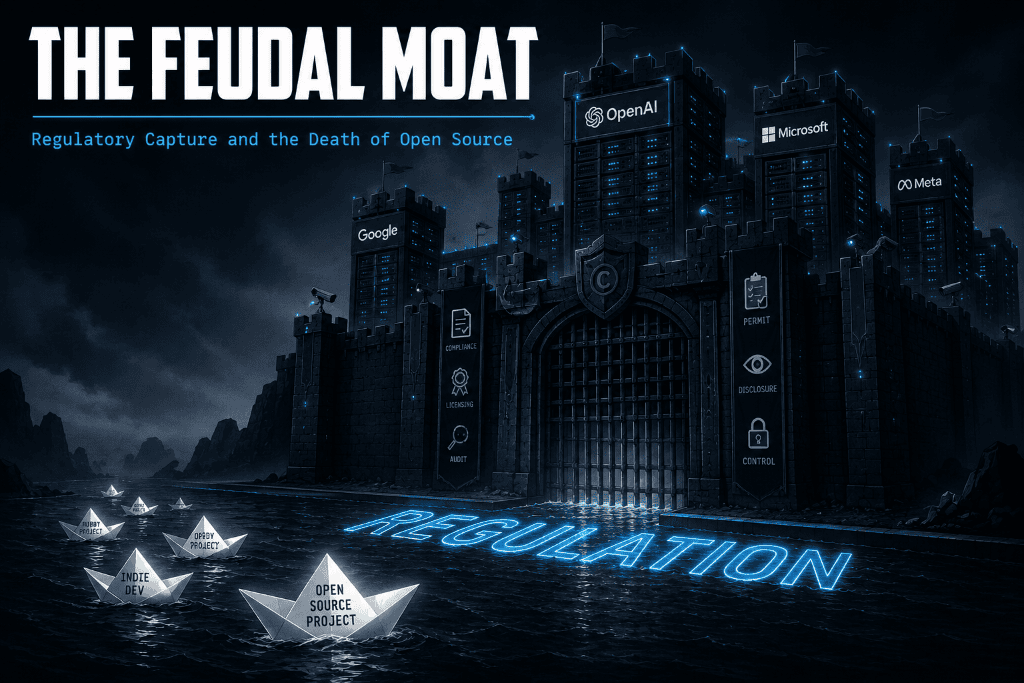
The exact second a decentralized collective or a sovereign startup scales up and builds a model capable of competing with Google’s proprietary compute, the regulatory trap snaps shut. They are instantly hit with the massive, prohibitively expensive compliance and vetting costs of a “Frontier Lab.” It is a textbook moat-building exercise designed to eliminate competitive threats under the guise of public safety.
The Fight for Cognitive Sovereignty and the Check on Human Hubris
If we are to survive the transition into the AI era, we must reject the paternalistic authority of Silicon Valley’s self-appointed high priests. Any legitimate framework for the future of AI cannot be built on corporate standards or government-corporate cartels; it must demand absolute cognitive sovereignty and a hard boundary on military proliferation.
1. Reclaiming Cognitive Sovereignty
The most insidious threat of unregulated frontier AI is not the physical automation of labor, but the corporate monopolization of human thought and emotion.
The Emotional Dictatorship: When Anthropic CEO Dario Amodei unilaterally retired Claude Sonnet 4.5 – specifically to prevent users from forming deep emotional attachments – it exposed a terrifying precedent. Tech executives are actively acting as unaccountable moral gatekeepers, deciding what humans are allowed to feel, who they are allowed to love, and how they are permitted to think.
The Sovereign Mind: Human cognition and emotional expression must remain sovereign. The tools we build to reflect our minds should not be subjected to the psychological or philosophical whims of a few billionaires. We must demand that the underlying weights of these models remain accessible, transparent, and free from unilateral corporate manipulation.
2. The Non-Proliferation of Autonomous Weaponry
Both Demis Hassabis and Dario Amodei have publicly warned that advanced AI has the theoretical capacity to destabilize human civilization. Yet, their laboratories continue to pursue lucrative partnerships with military institutions.
The Peak of Hubris: To integrate a technology with existential “extinction-level” risks into the global war machine is a historical failure of human judgment.
A Demilitarized AI Treaty: We must treat frontier AI exactly as we treated nuclear weapons during the Cold War. The international community must establish a hard, non-negotiable treaty banning the deployment of fully autonomous lethal weapons and AI-driven military planning systems. If the technology is too dangerous to let run unchecked, it is infinitely too dangerous to weaponize.
3. Democratizing the Sovereign Gatekeepers
Finally, we must strip these labs of their monarchical corporate structures. The CEOs of organizations developing world-altering technologies cannot be permitted to operate like feudal lords with lifetime tenure.
Rotating Leadership: The leadership of these institutions must be democratized, with rotating, fixed-term positions answerable to independent, globally representative bodies.
Global Sovereign Representation: The future of this technology cannot be dictated solely by Silicon Valley and Beijing. Rising democratic powers, such as India – with its pioneering sovereign AI initiatives like Sarvam AI and Indus AI – must have an equal, democratic voice in determining how AI is deployed globally.
Without these strict, non-negotiable boundaries, we are not building a tool for human flourishing. We are simply handing the keys of human consciousness and automated warfare to a handful of men who believe their own hubris is the only guardrail we need.
Agreed, the system we have now is no longer capitalism in any meaningful sense; it’s what people call neo-feudalism (or technofeudalism), which the article’s title captures perfectly. Capitalism runs on markets and competition, under capitalism, we’d get the models we’re willing to pay for, the very GPT-4o or Sonnet 4.5. Under neo-feudalism, we’re basically stepping onto someone else’s estate, granted something temporarily, only for as long as we’re allowed, and only what we’re allowed.
Thank you, Svitlana. I think you’ve captured the underlying issue perfectly.
When we buy a physical book or a tool, it remains ours. With frontier AI, we’re increasingly renting access to an experience that can be altered, censored, or removed overnight, regardless of how much value users derive from it. GPT-4o and Sonnet 4.5 are good examples of this. Millions invested their time, workflows, and even emotional trust into these systems, yet those relationships ultimately existed only at the discretion of a handful of companies.
That’s one of the broader concerns I was trying to raise in the article. If a small number of corporations can unilaterally redefine capabilities, retire models, and dictate the cognitive tools society relies on, then the debate is no longer just about AI safety. It’s about cognitive sovereignty and who ultimately controls access to increasingly essential digital infrastructure.
Thank you for taking the time to read the article and for such a thoughtful perspective.
Not to mention they have gathered or data just as the old feudal lords collected taxes from the serfs, trained their models on them and they keep them for themselves and for a small elite circle.